The language obligations of private businesses under federal jurisdiction are coming into focus with the publication, on July 18, 2026, of the draft Use of French in Federally Regulated Private Businesses Regulations.
These draft regulations form part of the process for implementing the Use of French in Federally Regulated Private Businesses Act (the “UFPBA”). Although it received royal assent in 2023, the UFPBA has not yet taken effect. Its purpose is to foster and protect the use of French within the businesses it covers by imposing new obligations on them. The draft regulations should therefore interest employers, since they set out, among other things, which businesses will be subject to the new federal regime and the steps they will have to take to comply.
The regulations are still in draft form and are therefore not yet in force. They are currently under a consultation period that will end on February 27, 2027. Until then, interested parties may submit comments directly on the Canada Gazette website.
Recap: How the UFPBA affects employers
In many respects, the UFPBA is the federal counterpart to the Charter of the French Language that applies to Québec businesses. It is important to note that the UFPBA will allow federally regulated private businesses to choose between the provincial regime under the Charter and the federal regime under the UFPBA. That choice must be carefully assessed, as the applicable obligations, compliance mechanisms and remedies will vary depending on the regime selected.
The new federal regime is built around three main components:
- The right to work in French. Covered employees must, among other things, be able to carry out their duties, be supervised, receive work-related communications, and use standard work tools in French. Employers may therefore need to revise their human resources documents, IT systems, and training programs, as well as the language requirements they set for a position.
- Promoting French in the workplace. Some businesses will need to establish a structured process to promote French, including forming a committee to promote French and performing an overview of the language situation.
- Customers’ right to be served in French. Covered businesses must be able to communicate with customers and provide them with services in French. They must clearly inform the public that these services are available. In Québec, French must be markedly predominant on commercial signage.
While the UFPBA establishes the general framework for these obligations, the draft regulations clarify their scope and how they apply. Below are the main changes they would introduce for employers.
1. Scope of the UFPBA: Does it apply to my business?
The draft regulations begin by setting the minimum thresholds for becoming subject to the UFPBA. These would be based on the number of employees the business had as of January 1 of the preceding year:
- In Québec: The UFPBA would apply to federally regulated private businesses with 25 or more employees in Québec.
- In regions with a strong francophone presence: The UFPBA would apply to federally regulated private businesses with at least 100 employees in Canada.
The draft regulations would also provide for new exemptions from the application of the UFPBA, particularly with respect to:
- Certain Indigenous businesses, as well as certain activities and workplaces located in Indigenous territories;
- Activities directly related to the production or distribution of cultural property whose linguistic content is exclusively in a language other than French;
- Activities related exclusively to the conduct of international business where the use of another language is predominant;
- Workplace activities governed exclusively or primarily by research protocols or international standards that require or favour the use of another language.
The scope of these exemptions varies. Some could exempt a business entirely from the UFPBA, while others would apply only to the provisions dealing with language of work.
2. Which regions outside Québec would be covered?
One of the key contributions of the draft regulations is the definition of “regions with a strong francophone presence,” since this concept determines which businesses located outside Québec would be subject to the UFPBA. Businesses that meet the applicable thresholds and have workplaces in designated regions would have to comply with the UFPBA.
These regions, whose precise boundaries are set out in a schedule to the draft regulation, would include:
- New Brunswick: the entire province.
- Nova Scotia: Yarmouth, Digby, and Richmond
- Ontario: Stormont, Dundas, and Glengarry; Prescott and Russell; Ottawa; Nipissing; Sudbury; Greater Sudbury; Timiskaming; and Cochrane
- Manitoba: 21 areas located to the east and south of the Winnipeg Metropolitan Area, including the Saint-Boniface area
- Alberta: certain areas in the Edmonton Census Metropolitan Area
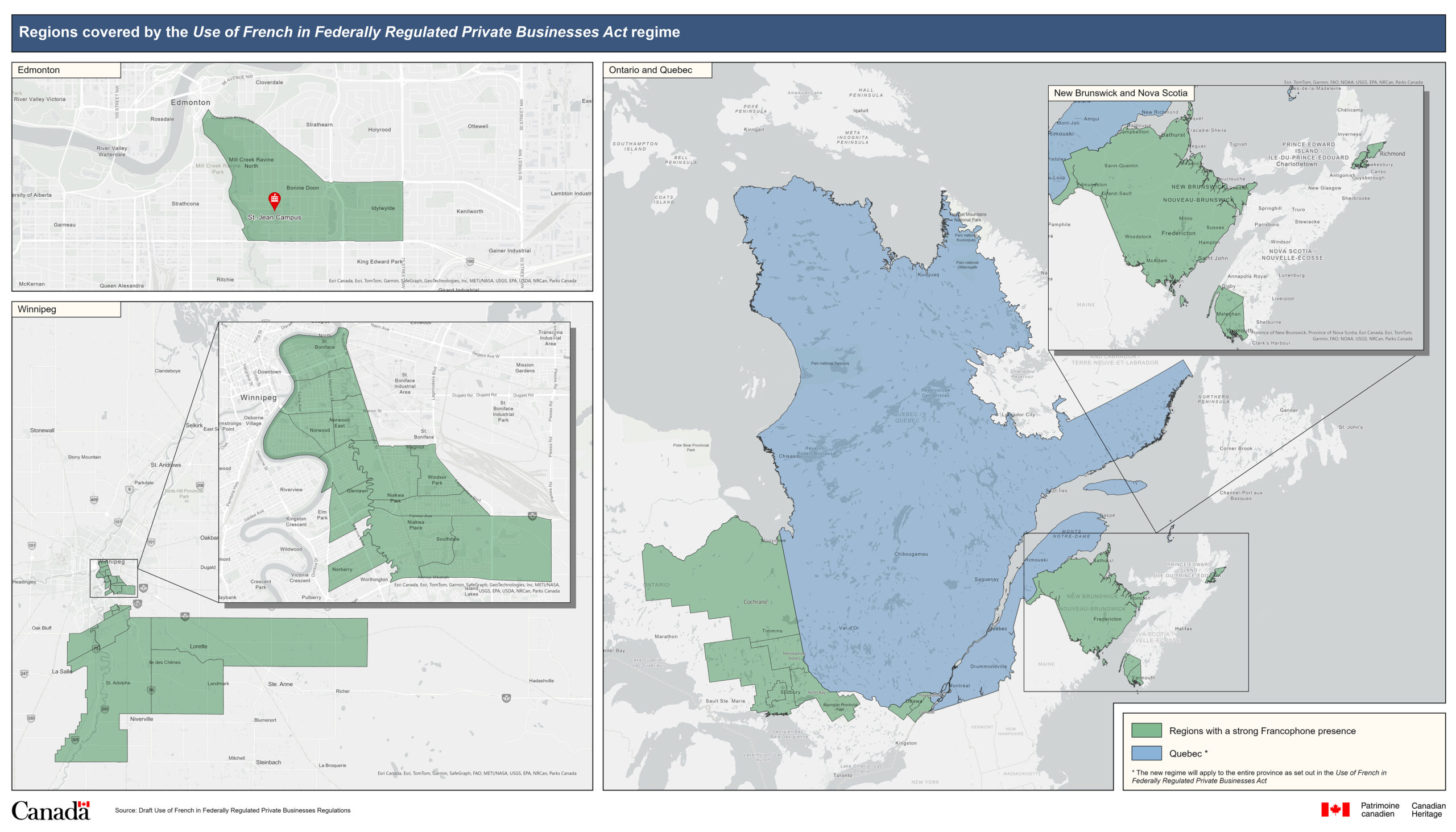
Source: An Act to support the use of French - Canada.ca
3. New administrative obligations for businesses
The draft regulations do not stop at defining the businesses and regions covered. They also set out new administrative obligations with which subject businesses would have to comply.
Subject businesses would, among other things, have to file an initial declaration with the federal government, and then annually confirm or update certain information regarding their workforce, workplaces, and, where applicable, their service locations and their means of communicating with customers.
The draft regulations would also specify which businesses would be required to establish a committee for fostering French:
- In Québec: This obligation would apply to businesses with at least 100 employees whose positions are attached to a workplace located in Québec.
- Outside Québec: It would apply to businesses with at least 100 employees across all regions with a strong francophone presence and at least 500 employees in Canada.
Businesses would have to establish their committee within six months of becoming subject to the UFPBA.
Practical advice for employers
Businesses will need to pay close attention to these obligations, since anyone who believes their language rights have not been respected may file a complaint with Canada’s official languages commissioner. Beyond the legal consequences, employers will also have to weigh the reputational risk associated with non-compliance.
In short, compliance with the UFPBA will call for structured analysis and concrete updates to internal practices. In Québec, the Act will take effect on a date to be set by order-in-council, which remains undetermined. It will take effect two years later in regions with a strong francophone presence.
Employers should check now whether the UFPBA affects them, map the applicable workplaces, review their human resources documents, assess their capacity to provide services in French, and determine whether they will need to establish a committee to foster the use of French. To ensure that the UFPBA comes into force in an orderly manner and without surprises, organizations should seek legal advice to help them develop and implement an action plan suited to their own circumstances.